
Lovable
Lovable is an AI full-stack app builder that turns natural-language descriptions into working web applications with frontend, backend, database, auth, and deployment. It is unusually effective at getting to a functional prototype and unusually poor at producing secure production code without human intervention; third-party scans find security issues in 99% of Lovable projects, and the managed backend creates migration friction that the code-portability narrative does not fully offset.
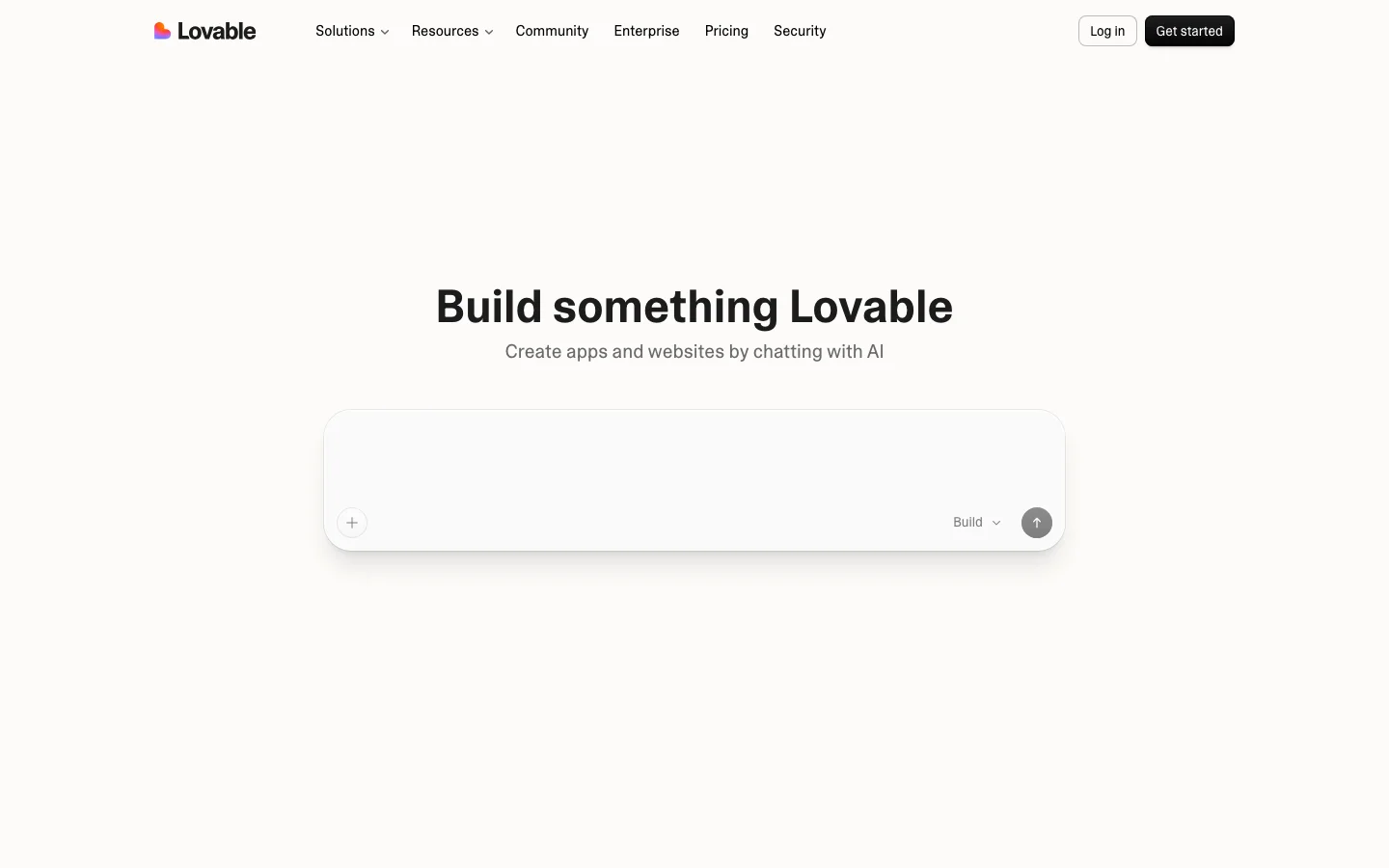
What is Lovable?
Lovable is an AI full-stack development platform built around a single premise: describe what you want to build in natural language, and Lovable generates a working web application — frontend, backend, database, authentication, and deployment — with editable code that can be synced to GitHub, GitLab, or Bitbucket[reference:0]. It is aimed at non-technical founders, product managers, designers, and operations teams who need to turn an idea into a working internal tool or MVP without starting from a blank codebase, as well as technical teams using it for rapid prototyping before bringing work into an existing engineering workflow[reference:1].
The product is best understood as two layers with different tradeoffs. The build layer — the chat-driven agent that generates and iterates on code — is fast and genuinely lowers the barrier to shipping a first version. The runtime and backend layer — Lovable Cloud, the managed Supabase instance, and the hosting — is where the portability claims meet friction. Code can be exported, but the database, auth configuration, and service-role access are not directly exposed. The consequence is that Lovable is more portable in theory than in practice for applications that have already accumulated data and integrations in Cloud.
The security dimension is not a footnote. An independent July 2026 audit of 424 AI-generated projects found that 99% of Lovable projects carried at least one security finding, with a median of 644 issues per project. Supabase-backed apps — which account for 84% of Lovable projects in the sample — carried 2.4x the security-issue density of non-Supabase apps, driven by client-side exposure patterns that the BaaS model makes easier to misconfigure. A February 2026 disclosure documented a specific Lovable-hosted app in which an AI-generated authentication function inverted its access control: it blocked authenticated users and allowed unauthenticated access to every user record, exposing over 18,000 accounts including student data[reference:3]. Lovable has since shipped built-in security scanners and optional Aikido/Wiz connectors, but the baseline finding — that the default output is not secure by default — remains the most consequential limitation for anyone considering production use.
How does Lovable work?
A user describes an application in natural language inside a project. Lovable's agent interprets the request, generates React/TypeScript code, and provisions backend infrastructure. On Free, Pro, and Business plans, the default backend is Lovable Cloud, a managed Supabase instance that handles the database, authentication, file storage, and real-time updates[reference:4]. Users can alternatively connect their own Supabase project, but there is no one-click migration between the two, and switching after data and auth users exist is a manual process[reference:5].
The agent operates in multiple modes. Default Mode consumes credits based on task complexity; Plan Mode costs 1 credit per message and produces a plan before code changes are made. Chat mode allows questions and exploration without modifying the codebase. The project maintains a chat history, a code view, and version history, and each message's credit cost is visible after it is sent[reference:6]. Code sync is available on every plan, including Free, and creates a private repository owned by the user's GitHub/GitLab/Bitbucket account[reference:7].
Deployment is one-click to a lovable.app subdomain. Custom domains require a paid plan. The default hosting is Lovable's infrastructure; deploying to the user's own infrastructure requires exporting code via Git sync and handling the backend separately. Enterprise adds options for Git sync data residency and EU inference.
Use Cases
- Non-technical founders and product managers building a functional MVP or internal tool with authentication, database, and payment integrations, where the goal is validating a workflow with real users rather than shipping production infrastructure
- Prototyping and stakeholder demos where speed matters more than code quality, and where the output will be reviewed, hardened, or rebuilt by engineers before reaching production
- Operations, sales, marketing, and HR teams replacing spreadsheets or per-seat SaaS tools with lightweight custom applications that run on the Lovable stack and do not need to be portable to another infrastructure[reference:8]
- Agencies and consultancies delivering client prototypes where code ownership matters and Git sync provides a handoff path, but where the client should understand that the backend layer remains Lovable-managed unless independently provisioned
- Technical teams using Lovable to scaffold a project structure, generate boilerplate, or explore a UI direction before moving the work into a conventional engineering workflow — with the explicit understanding that the generated code should be treated as a starting point, not a reviewed baseline
Pricing
Pricing model: Freemium
| Plan | Price | Billing | Included usage | Notes |
|---|---|---|---|---|
| Free | Free | — | 5 daily build credits, capped at 30 per calendar month. 20 monthly Cloud credits for hosting, database, and storage. 4 monthly AI credits to test in-app AI features. Unlimited collaborators. Private projects. Invite-only publishing. No credit card required. | — |
| Pro | From $25 | per month | Monthly subscription credits from 100 to 10,000. Includes custom domains, Lovable badge removal, code editor, per-member credit limits, credit rollovers, on-demand top-ups, and 5 daily build credits (no monthly cap). Unlimited users; credits are workspace-based, not per-seat. | — |
| Business | From $50 | per month | Monthly credits from 100 to 10,000. Everything in Pro, plus SSO, team workspace, role-based access, workspace publishing, security center, design templates, data training opt-out, and priority support. Unlimited users. | — |
| Enterprise | Custom | quote-based | Volume-based credit pricing. Directory sync (SCIM), audit logs, publish/invite restrictions, auto-retire abandoned apps, scheduled deep security scans, sensitive data detection, Git sync data residency, EU inference, GitHub Enterprise (cloud or self-hosted), private npm registry, named CSM, custom SLA. | — |
Common Limitations
- Security debt is the defining structural limitation · An independent July 2026 scan of 424 AI-generated projects found that 99% of Lovable projects had at least one security finding, with a median of 644 issues per project — roughly 4.5x the median of any other platform studied. Only 2 of 183 Lovable projects were clean on security. The scan noted that 84% of Lovable projects are Supabase-backed, and Supabase-backed apps in the sample carried 2.4x the security-issue density of non-Supabase apps. A separate February 2026 disclosure documented a Lovable-hosted app with 16 vulnerabilities (6 critical) that exposed over 18,000 user records, caused by a logic inversion in authentication — blocking logged-in users while allowing unauthenticated access.
- Lovable Cloud is a managed Supabase backend with no direct database access · Projects using Lovable Cloud run on a managed Supabase instance that does not appear in the user's Supabase dashboard. There is no direct SQL editor access, no service-role key visibility, no ability to customize auth email templates, and no direct database URL or credentials to hand to a contractor, BI tool, or external service. Auth is limited to Google and email out of the box. There is no one-click migration between Lovable Cloud and an owned Supabase project; switching requires a manual, multi-step process and risks secret conflicts. The practical consequence is backend lock-in even when the code itself is portable.
- Credit consumption is opaque and includes the cost of fixing agent-introduced bugs · Lovable bills per message based on an algorithmic estimate of task complexity. Users cannot know the exact credit cost of a prompt before sending it; only the consumed amount is visible afterward. Because the same credit balance pays for building, chat beyond the daily allowance, Cloud hosting, and in-app AI features, monthly cost depends on how much a team builds and hosts, not just on seat count. User reports consistently describe a cycle in which the agent introduces a bug, the user spends credits asking it to fix the bug, and the fix introduces or fails to resolve the issue — compounding cost without proportional progress. One review described the agent as 'telling you it made changes' that were never implemented.
- Production readiness requires substantial human engineering · Lovable's own documentation positions the product for production-grade applications, but independent analysis and user accounts draw a sharper line: the platform is strong at getting to a working prototype, and weaker at getting to a secure, maintainable, scalable production system. The issue density data — 18.1 issues per 1,000 lines of code, 7.8 in the scalability bucket — reflects code that functions but carries hidden maintenance and security debt. A 2026 consumer insights report identified 'Bug and Error Handling' and 'Project Stability and Reliability' as the worst-performing themes, while prototyping and ease of use were the best-performing themes.
- Framework migration introduces legacy divergence · TanStack Start became the default for new projects on May 13, 2026 (June 22 for Enterprise). Projects created before that date still use the previous React + Vite stack and require a manual upgrade path. This means documentation, community advice, and generated code patterns may assume TanStack Start while a substantial installed base of older projects operates on a different stack. Users starting today are on the current framework; users with existing projects face a migration decision that is not automatic.
- Data training policy varies by plan · Data training opt-out is only available on Business and Enterprise plans. Free and Pro subscribers do not have access to this privacy control. For individuals or small teams working with proprietary code, client material, or sensitive business logic on a Pro plan, this is a documented gap, not an inferred one.
- Customer support and billing friction are recurring complaints · User reviews across Gartner Peer Insights, Trustpilot, and consumer insights analyses consistently surface billing disputes (charges for services not used), unresponsive support during complex issues, and difficulty getting resolution when the agent enters unproductive loops. One Trustpilot reviewer described the product as 'unusable beyond simply prototyping needs' after a period of declining agent reliability. These are not universal experiences, but they are recurrent enough to be a documented risk factor rather than isolated noise.
Key Features
- Natural-language full-stack app generation (frontend, backend, database, auth)
- Lovable Cloud managed Supabase backend with database, authentication, and storage
- One-click deployment to lovable.app subdomains
- Custom domains on paid plans
- Git sync to GitHub, GitLab, and Bitbucket (including on Free plan)
Lovable vs. v0, Bolt.new, and Replit
This comparison uses official pricing documentation, an independent July 2026 security scan of 424 AI-generated projects, and verified user reports. Lovable, v0, Bolt.new, and Replit are all prompt-to-app tools, but they occupy different positions: Lovable is the most opinionated full-stack builder, v0 is component-and-ecosystem-oriented, Bolt.new prioritizes browser-based speed and low friction, and Replit offers a complete cloud IDE. The comparison focuses on documented output quality, backend control, and migration friction rather than marketing claims. Pricing and capabilities can change and should be verified against current vendor pages.
| Tool | Positioning | Key differences | Best fit | Pricing note |
|---|---|---|---|---|
| Lovable Official pricing Subscription plans documentation State of AI-Generated Code 2026 (security scan) | An AI full-stack development platform that generates web applications with frontend, managed backend, auth, and deployment from natural language. | The fastest path to a working full-stack prototype with auth and database, and the highest documented security debt among its direct peers: 99% of projects with at least one security finding, median 644 issues per project, 18.1 issues per 1,000 lines of code. Lovable Cloud provides a managed Supabase backend but restricts direct SQL access, service-role keys, and auth customization, creating backend migration friction that code export does not resolve. Credit consumption is complexity-estimated and includes bug-fix cycles. Data training opt-out is Business-tier only. | Non-technical founders, product managers, and operations teams who need a functional full-stack MVP with auth and database quickly, and who have access to engineering review before exposing the app to real users or sensitive data. Also viable for agencies delivering client prototypes where Git sync provides a handoff path and the backend scope is understood. | Free (5 daily credits, 30/month cap, 20 Cloud credits, 4 AI credits). Pro from $25/mo (100–10,000 credits, custom domains, code editor). Business from $50/mo (SSO, security center, data training opt-out). Enterprise quote-based. Credits shared per workspace; unlimited users on all plans. |
| v0 by Vercel State of AI-Generated Code 2026 (security scan) Morphllm vibe coding tool comparison (April 2026) | Vercel's AI UI and component generation tool, optimized for React and Next.js within the Vercel deployment ecosystem. | Less backend-opinionated than Lovable: v0 generates React/Next.js components and pages with tight Vercel integration, but does not provision a managed auth and database layer in the same way. In the independent security scan, v0 sat in the same 'dirty tier' as Lovable on issue density (16.6 issues/KLOC, 92% of projects with a security finding), but with a lower median of 94 issues per project. The migration path is cleaner for teams already on Vercel, and there is no managed-backend lock-in comparable to Lovable Cloud. Pricing starts at $20/mo with a free tier that includes $5 in credits. | Teams and developers already standardized on React/Next.js and Vercel who want AI-generated UI components and pages that deploy directly into their existing pipeline, with less backend opinionation and a clearer path to full code ownership. | Free tier with $5 credit; paid plans from $20/mo. Credit-based consumption. No managed-backend lock-in. |
| Bolt.new State of AI-Generated Code 2026 (security scan) Morphllm vibe coding tool comparison (April 2026) | An in-browser AI development environment built on WebContainers, optimized for fast prototyping and hackathon-style demos. | The lowest-friction option in this set: Bolt runs entirely in the browser, starts from a free tier with 1M tokens, and is explicitly positioned for fast prototypes and throwaway apps rather than production systems[reference:15]. In the independent security scan, Bolt produced the cleanest output of the prompt-to-app tools studied: 11.4 issues/KLOC, 67% of projects with a security finding, median 143 issues per project — roughly half the issue density of Lovable and v0. The tradeoff is scope: Bolt's output is less full-stack-opinionated than Lovable's, and it is not designed for sustained production operation. | Fast prototypes, demos, and throwaway applications where speed and cost matter more than durability, or as a low-risk way to test whether a prompt-to-app workflow fits before committing to a full-stack platform. | Free tier with 1M tokens; paid plans from $25/mo with token rollover. Lower commitment and lower production expectation than Lovable or Replit. |
| Replit Morphllm vibe coding tool comparison (April 2026) The AI Agent Index: Best vibe coding tools (Nov 2026) | A browser-based cloud IDE with an AI Agent for building and hosting full applications, supporting a broader range of languages and deployment contexts than single-framework builders. | The closest to a complete development environment in this comparison: Replit provides a cloud IDE, multi-language support, and an Agent that can build and host applications inside the same platform. It is less specialized than Lovable on the 'full-stack from chat' experience, but offers more control and a broader technical surface. The tradeoff is that Replit assumes more user involvement in architecture and configuration; it is not as turnkey for non-technical users. Pricing starts at $20/mo for the Core plan, with effort-based Agent billing on top. | Users who want to build, run, and host in one browser-based environment and are comfortable with more hands-on configuration than Lovable requires; teams that need language flexibility or a development environment that extends beyond a single framework's opinionated stack. | Free Starter plan with daily Agent credits; Core from $20/mo; Agent usage billed by effort per checkpoint in addition to the subscription. |
Comparison checked against official product information on 2026-11-04. Features and pricing may change.
Frequently Asked Questions
Is Lovable suitable for production applications?
It depends on what 'production' means for your context. Lovable can generate a working application with authentication, database, and deployment, and the platform markets itself as production-capable. But independent data tells a different story about default output quality: 99% of Lovable projects in a 2026 scan had at least one security finding, with a median of 644 issues per project. The realistic assessment is that Lovable is excellent at getting to a functional prototype and requires human engineering review, security hardening, and often architectural cleanup before it is safe to expose to real users or sensitive data. Teams without access to a developer who can review generated code should not treat Lovable's output as production-ready by default.
Do I own the code that Lovable generates?
Yes, according to Lovable's documentation: 'You own what you create. Your apps, code, and content you create with Lovable are yours, subject to third-party rights such as open-source licenses'[reference:9]. Code can be synced to a private GitHub, GitLab, or Bitbucket repository on any plan, including Free. However, ownership of the code is distinct from control of the backend. If you use Lovable Cloud, the database, auth users, and service-role access live in a managed Supabase instance that does not appear in your own Supabase dashboard and does not expose direct SQL access. Exporting code without migrating the backend leaves you with a frontend and API layer that still depends on Lovable-managed infrastructure[reference:10].
Why do users report that Lovable consumes more credits than expected?
Three mechanics drive the gap between expected and actual credit consumption. First, credit cost is determined by an algorithmic complexity estimate, so users cannot know the cost of a prompt before sending it — only after. Second, the same credit balance pays for building, chat, Cloud hosting, and in-app AI features, so a team that deploys and hosts an app consumes credits even when nobody is actively building. Third, and most frustrating according to user reports, when the agent introduces a bug, the user spends additional credits asking it to fix the bug — sometimes across repeated cycles where the fix fails or introduces a new issue. One consumer insights report identified 'unclear credit usage while facing high costs and frequent credit depletion' as a top opportunity area[reference:11]. The practical mitigation is to use Plan Mode for complex changes, work in small increments, and set per-member credit limits on shared workspaces.
What is the difference between Lovable Cloud and connecting my own Supabase?
Lovable Cloud is a managed Supabase instance provisioned and controlled by Lovable. It is the default backend and the path of least resistance, but it comes with deliberate constraints: no direct SQL editor access through supabase.com/dashboard, no service-role key or direct database URL, no custom auth email templates, and auth limited to Google and email out of the box[reference:12]. Connecting your own Supabase project gives you full database access, custom auth configuration, and the ability to hand credentials to external tools, but it requires manual setup and there is no one-click migration between the two backends. The decision should be made early: switching after data and auth users exist is a manual migration, not a toggle.
How does Lovable compare to v0, Bolt.new, and Replit?
Each tool occupies a different position on the prototype-to-production spectrum. Lovable is the most opinionated full-stack builder — it provisions a backend and auth out of the box, which is why it is the fastest path to a working full-stack prototype, and also why its security and migration tradeoffs are the most pronounced. v0 is tighter and more component-focused, strongest when the output is React/Next.js destined for Vercel, with less backend opinionation. Bolt.new is the lowest-friction browser-based option, best for throwaway prototypes and demos where speed and cost matter more than production hardening. Replit is the closest to a complete development environment, with a cloud IDE and broader language support, positioned for users who want to build and host in one place rather than export to an existing workflow. The independent security scan placed Bolt in a cleaner tier than v0 and Lovable, which is consistent with Bolt's narrower scope and shorter-lived output profile.
Alternative Tools
-
 Bolt.new Bolt.new is StackBlitz's in-browser AI full-stack app builder. It runs a Node.js runtime inside your browser tab, installs packages, starts dev servers, and generates full-stack code from prompts—no local environment setup required.
-
 Replit Replit is a browser-based IDE with an autonomous Agent 3 that builds, tests, and deploys apps from natural language, running up to 200 minutes without supervision. Core at $20/month is the real entry point; Starter is a demo tier. Effort-based billing, documented agent reliability issues, and a pattern of billing and support complaints are material risks for production use.
-
 Cursor Cursor is an AI-first code editor built on a VS Code fork with agent mode, Tab completions, and cloud agents.
-
 GitHub Copilot GitHub Copilot is an AI coding agent embedded across GitHub, IDEs, the terminal, and the web. It combines unlimited completions on paid plans with agent mode, asynchronous coding agents, and code review, but its value depends on disciplined review, awareness of IP and data-training policies, and realistic expectations about PR acceptance rates and context limits.
-
 Ollama Ollama is an open-source local LLM runtime and model manager that makes running open-weight models on your own hardware a single command. Local inference is free and unlimited; the costs are hardware, VRAM-gated context defaults, and a documented security surface that requires deliberate network isolation.
-
 OpenAI Codex OpenAI Codex is an agentic coding product bundled into ChatGPT plans, spanning CLI, IDE, desktop, and cloud. Plus at $20/month is the real entry point; Free and Go are demos. Usage is credit-metered with wide ranges, ChatGPT and Codex pools merge in December 2026, and disclosed security boundary issues remain relevant for teams evaluating it for sensitive codebases.